

Welcome to Parsing Out, the flagship writing/audio series for External Drive. Parsing Out focuses on diving deep into a game, its meaning, and its context. That said, this is my first go at this, I am incredibly rusty, and I am trying to set this site up while also working a full-time job. The audio reading of this will be up sometime within the month. All said, I know this is a fairly rough piece and thank you for giving it a fair shake, warts and all. But, don’t let my anxiety-induced caveats blasting stop you from (hopefully) enjoying my thoughts on the Mass Effect series.
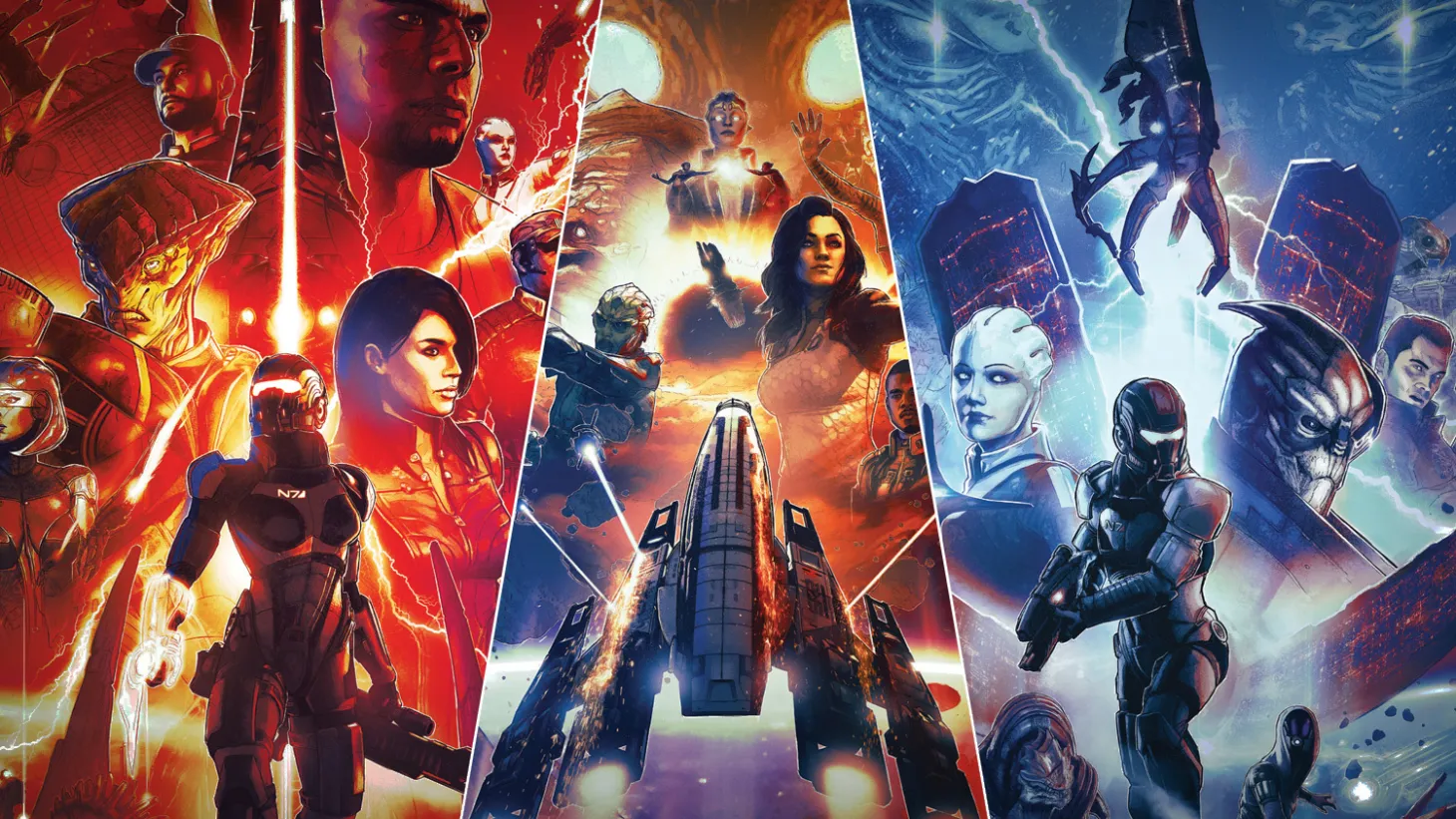
Mass Effect was one my first games. That’s not to say it was one of the first games I ever played, but it was one of the first video games I bought for myself with my money and played by myself. No specific friend or acquaintance told me “yo, Mass Effect, you should check that out, bro”. I simply knew that this “Mass Effect” series of video games was widely considered by players and critics to be good. So at high-school age, sitting on my bedroom floor, new laptop on a coffee table that was at about chest height with my back against my bed and my butt on a thin pillow that definitely did not provide any lumbar support, I played through all of the Mass Effect Trilogy. According to Steam, I have 97.3 hours played in Mass Effect and 171.5 hours in Mass Effect 2. These are a couple of my favorite comfort food games. I’ve beaten Mass Effect 2 over 5 times, and since I require myself to import a fresh Mass Effect save nearly every time I start Mass Effect 2, that means I’ve beaten Mass Effect almost as many times as I have beaten Mass Effect 2. I love these two games. The re-release of this trilogy in the Mass Effect Legendary Edition has many people revisiting their memories of the original games, and wondering if these games hold up a decade later. So if Mass Effect marked an early key point for my relationship with playing video games, what better franchise to christen my new critical writing relationship with games. And just like the Mass Effect series itself, my writings and feelings are sure to be messy and complicated. Mass Effect is a series that routinely makes promises and doesn’t deliver on many of those promises, but delivers in so many other key areas that it still satisfies almost a decade later. Even if the series refuses to grow out of its own shadow.
Mass Effect: Starry Eyed
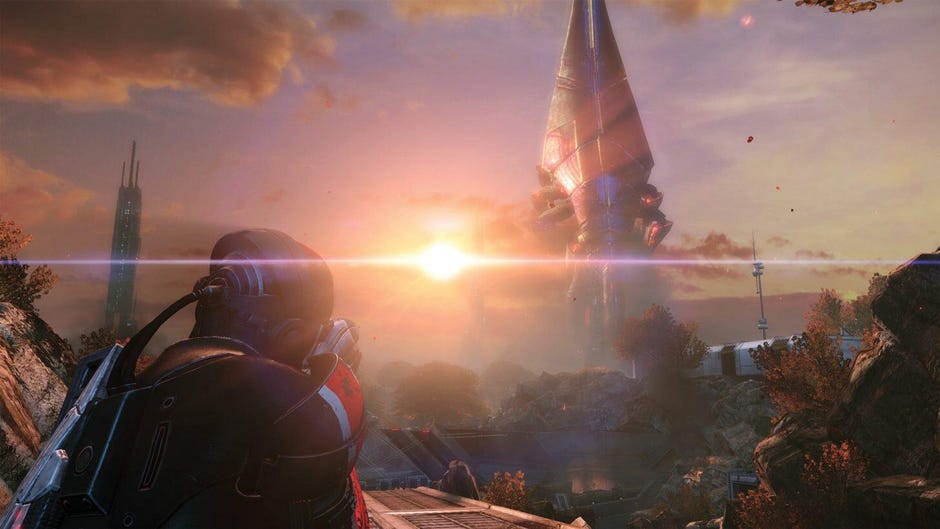
Mass Effect marked the culmination of Bioware’s ambitions. They had made their mark with the Baldur’s Gate games, seminal PC RPG games based in the Dungeons & Dragons world and rule set. But their first ever game was an original IP set in an original sci-fi universe titled Shattered Steel. Shattered Steel was obviously based on the BattleTech universe, namely the popular Mecha piloting games series MechWarrior, but Bioware always possessed a drive to make their own worlds while drawing heavily on dear inspirations. After years of making D&D games, an acclaimed Star Wars RPG, and one lukewarm attempt at a Chinese martial arts RPG, Bioware took another crack at creating their own blockbuster sci-fi RPG series. Mass Effect, as Shattered Steel before it, is obviously inspired by its creators’ love of classic sci-fi material. Bioware’s dev team has a deep abiding love for their inspirational material, and beyond that, they wanted to create something that made people feel what they felt about Star Wars and Star Trek. And they accomplished that mission. They knew they couldn’t introduce space magic that was just a rebranded The Force, or show up with lightsabers with the serial numbers filed off. They had to create new concepts that could fuel fan fictions for years to come. Drew Karpyshyn, Mac Walters, and Casey Hudson put in the work to make a singular space fantasy epic with hard enough sci-fi edge to satisfy owners of Star Trek: The Next Generation Technical Manual. The attempt to find the happy medium between not just Star Wars and Star Trek, but classic stat-driven RPG and third-person action shooter is valiant and bold, even if the final product doesn’t quite fulfill that mechanical potential. Looking at the lore and world building, Mass Effect is a mostly resounding success. The brilliance of the decision to use your diverse teammates as walking, talking codex entries resounds throughout this game and many of Bioware’s other successes. Sure, you could be a sequestered space hermit and learn about the Asari through the narrated in-game wiki, or you could be an attentive commander and talk to Liara about how she’s experienced the culture of Mass Effect’s brand of Blue-Skinned Space Babes. It is a testament to the character writing of these games that Mass Effect introduces an all-female society of pansexual humanoids and it is both as pandering as that sounds while also leading to some of the most memorable characters in the series. Learning about the fictious Milky Way through your companions creates an emotional bond to the world, because you’re not just reading a text entry explaining that the quarian government is set up with a conclave and admiralty board that can override the conclave when deemed necessary, but you are listening to this cool looking alien who has lived in it explain it to you with occasional flavor text about how her father is high up in the government and how that’s affected her. Wrex’s stories about the decline of krogan civilization caused by their uplifting and subsequent abandonment hit much harder coming from a party member than they would coming from the steady voice of the codex narration. The genophage, despite being maybe the best narrative hook in Mass Effect, is a good point to highlight a key downfall of Mass Effect, and by extension, a lot of choice-driven RPGs to follow. The genophage is a biological weapon deployed against the krogan far before that start of the first game. This pathogen was meant to slow the birth rate of the krogan by causing the vast majority of krogan births to be stillbirths. Characters throughout the games try and explain the grey-ness of the situation, but the bulk of discussion around the genophage takes the presumption that it is a horrendous act that should be rectified. Most often the blue-coded Paragon dialogue options push back against genophage apologists across all three games, but that means there’s other dialogue options as well. Mass Effect, in its binary morality malaise, constantly offers the player the decision to “both sides” situations, to let the player role-play as a bad guy or a goody-two-shoes. In the case of the genophage, this means you can play as a genocide apologist. This is bad. I do not like it. Unless there are dire story developments built around it, do not let me role-play as a genocide apologist, please. No matter how large of a jerk you are, no matter what genocides you excuse, Shepard will have to be perceived as the noble savior of the galaxy. Noble Space Boy Scout or Angry Hair Trigger Soldier, the most important aspect of Shepard on multiple playthroughs becomes their skill with firearms and violent space magic. On a first playthrough, it can pull the wool over your eyes. Despite all the information being surfaced, the Paragon/Renegade system can trick you into thinking it is deeper than just making sure you choose the options on the top or bottom half of the dialogue wheel to build up the blue or red meters, respectively. But after more than one game, heck, after the first game, you see through the thin ruse and simply commit to being all blue or red. We’ve seen role-playing games handle player character reputation better. Bioware has handled this better. Disco Elysium lets the player play as a fascist sympathizer and portrays that as the pathetic, angry, sad existence it is. Dragon Age Origins doesn’t have a universal reputation meter, rather each companion character will approve or disapprove of your actions and dialogue choices which unlocks extra conversations if they like you enough or they leave the party if they can’t vibe with your decisions. And Fallout: New Vegas takes that model and applies it globally. Your player character in New Vegas has a reputation with every faction in the world. You can curry favor with the bandit raider factions or get in the good graces of the bureaucratic New California Republic. I understand that Mass Effect is born from a love of Star Wars, so it follows that Bioware would use a morality/reputation system similar to the Light Side/Dark Side meter from their previous game, Knights of the Old Republic, but I wish they had made something less rigid. If you’re looking for a game about the supposed necessity of dicey moral choices in an imperfect world on the brink of destruction, Mass Effect isn’t that game. Mass Effect is a game where 90% of your decisions are cut and dry, black and white, blue and red, and you have to blow up the robot squid. I maintain that the Paragon/Renegade system is one of the most damaging aspects of the Mass Effect series, not just to itself, but to major video games as a whole. That said, it is worth noting that most players (by Bioware’s reporting nearly 90% of players) do not ever “go Renegade”. A testament to the strength of the character and dialogue writing that even after realizing none of the dialogue decisions have material costs or risks, players still want to be the nice guy because they do not want to be mean to the people in this world. Choosing to write every decision as simple binaries of “save the babies or gleefully steal every lollipop from every child on every planet” makes it easier to plan the impact of said choices, but it leads to grim morals and disappointing replays when you discover that at the end of the day, racist or not, you still win the day and are a Hero. I understand that people say they do not want “politics” in their games or any media. That includes real world politics being referenced as well as making the player navigate and understand the politics of the game world. But, Mass Effect is at its strongest when you are forced to navigate the political systems and bureaucracy. “Politics” means talking with people, the best part of Mass Effect games. Coming to know the world and its workings is what people remember about Mass Effect, both the game and the series. Take away the political intrigue and the dedication to teaching the player about these fictional alien cultures and you end up with Mass Effect andromeda, the most combat-focused Mass Effect title. And it is BAD. I have so much love for Tali, Liara, Garrus, Wrex, and the background of the fictional cultures they each come from. Even though I already know their backgrounds I exhaust their dialogue on each replay because at the end of the day, Mass Effect is a game about talking to people and learning about them. It is ok if our choices don’t shape the fate of the entire world, they can just shape our relationships within that world. In a series about shooting space guns at space mercs and rescuing the galaxy from an eons old threat that the dang space politicians don’t acknowledge, the points and moments of the Mass Effect trilogy that remain with me are the dialogue choices I made with the characters I care about. Whether those decisions were mechanically “important” or not doesn’t register with me anymore, but I remember Shepherd hugging Tali after you find her father dead in a hall. I remember stopping Garrus from (further) brutalizing a criminal. I remember talking down Wrex on Virmire. And I do “remember” the climaxes of Mass Effect 3, but they are disappointingly, although not entirely out-of-character for the series, trite and brief and simplistic. But after all is said and done Mass Effect ends up more concerned with Epic Moments than it is with the compelling character’s and setting it sets up. And that would be the legacy of the franchise going forward.
Mass Effect was originally announced as a trilogy, a move that only one other foolish AAA publisher has attempted thus far. A key aspect of both the in-game and marketing narratives was that choices made in one game would carry over and affect the subsequent games. With this in mind, Mass Effect’s first installment had the primary task of making the player invested in this setting. As such, it makes sense that the lore and character place setting takes precedent in Mass Effect, leaving the shooting action comparatively unpolished. No person who has played more than 3 electronic video games would claim the aiming and shooting in Mass Effect feels good across the board. Even next to its contemporaries, Mass Effect possesses shooting both stiff and sluggish. The target reticle is often inaccurate to the actual spread of the player’s shots and if you aren’t keeping a close eye on your target’s health bar the effectiveness of your shots is difficult to discern. Although I personally do enjoy the decision to have sniper rifles be as wavy and loose as they are, it makes landing a headshot that much more satisfying. And there is a uniquely pleasing quality in reaching the endgame with shotgun stats so high that your shotgun is as accurate as a pistol. But these are affections I have gained over 100+ hours of play. I haven’t found another shooting game with a player empowerment curve quite like Mass Effect’s, but, I have not played every shooting game ever made. Rectifying the shortcomings of the combat was a key focus in Mass Effect 2’s development. Mass Effect made a splash by calling its narrative’s shots and getting its interspecies sex scenes broadcast on FOX News, but now it was time to polish.
Mass Effect 2: Super Space Bros.
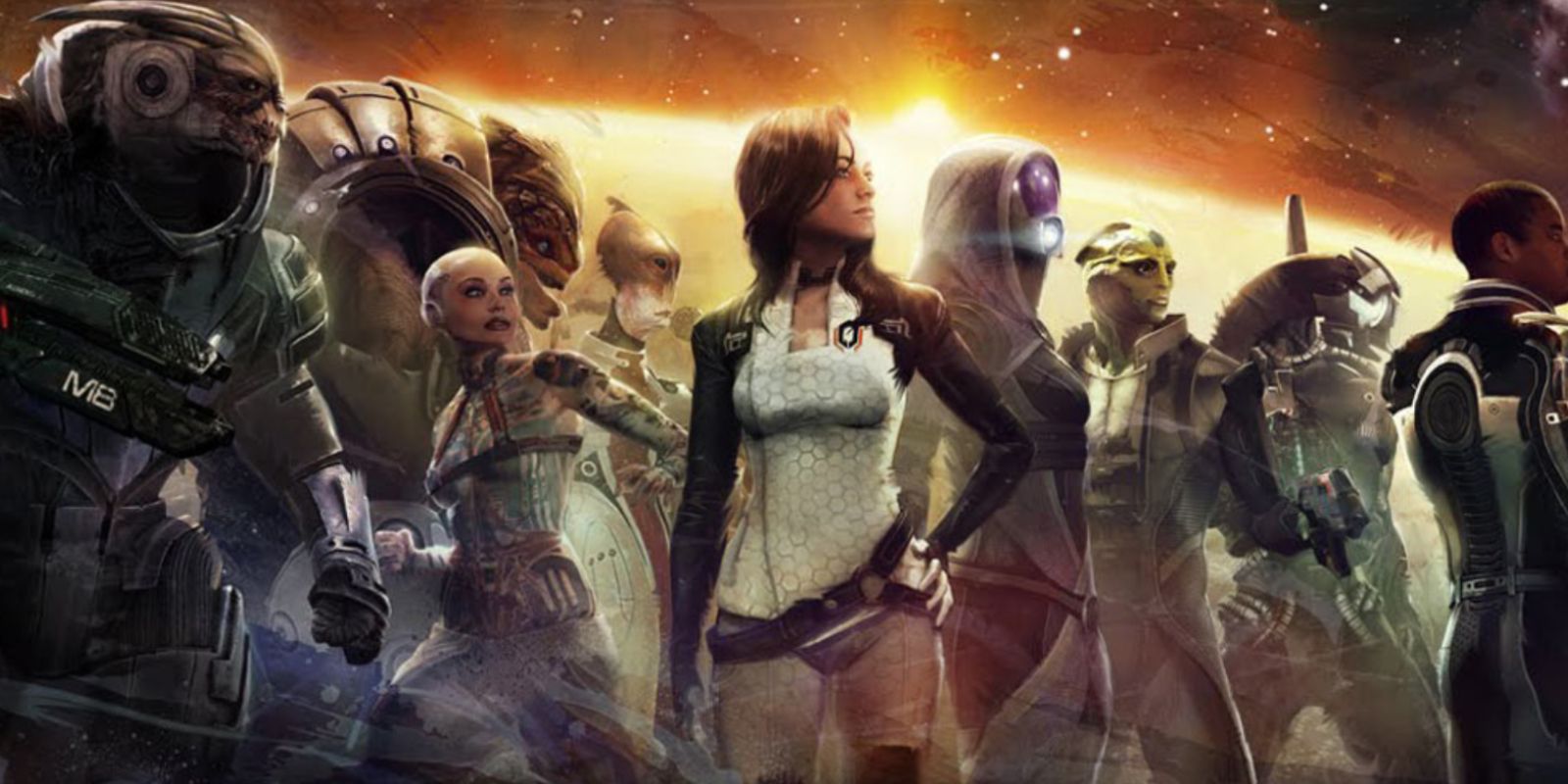
Mass Effect 2 starts with a literal “bang”. The Normandy, your ship from the previous game, equal parts Millennium Falcon and Enterprise, gets blown up in the first 5 minutes of Mass Effect 2 and Shepard is dead. Of course within the next 30 minutes Mass Effect 2 reveals that Shepard’s “death” was an excuse to allow new and returning players a stab at character creation. With Shepard resurrected and acquiring the Normandy 2 inside of an hour, it could be easy to write off the explosive opening scene as a cheap hook or gimmick. But whenever I replay Mass Effect 2, I never skip the opening cutscenes. Even knowing all of the loudest destructions are undone almost immediately, it works. It pushes me to pursue the destroyers and recover my old teammates. The destruction of the old Normandy and Shepard’s death also fit the new tone of Mass Effect going forward: action, explosions, industry standard over-the-shoulder shooting controls, and comfort defying clothing options. In hindsight, the de and reconstruction of the Normandy also signals, unknowingly, the departure of the core aesthetic and tone of the original. It will be replaced with a sleeker, larger version that possesses totally different inner workings. Mass Effect 2 marks my favorite overall entry in the series (with a key caveat being an imported Mass Effect save) and a point of contention for fan discussion. It is widely believed that Mass Effect is the rough template, Mass Effect 2 is the peak, and Mass Effect 3 is the “bad” one. This paradigm was at its height in the years immediately after Mass Effect 3’s release. In the ensuing calm, as anger cooled and more constructive conversations could be had without someone barging in to shout about how much the ending of Mass Effect 3 sucks, the talk became that Mass Effect 2 was where it had all begun to go wrong. The ills seen in Mass Effect 3 had been seeded in Mass Effect 2 and Mass Effect 2 betrayed the soul of the first Mass Effect, or so the arguments go. And despite my undying love for Mass Effect 2, these statements and sentiments are correct. Mass Effect 2 is one of the best buddy action experiences made, but the tilt toward action sequences over spacey vibes does warn of the diminishing core of Mass Effect. People don’t talk about their favorite shooting level in Mass Effect games. They don’t spend pages and pages on forums and hours on podcasts recounting the combat encounters. The decision to improve the combat interactions is a welcome one, but leaning into the combat as a core substance of the game is in my eyes and in the long run a mistake. Mass Effect 2 as a whole lacks meaningful additions to the series’ main arc outside of a killer ending shot that always tricks me into thinking I will enjoy Mass Effect 3, but you most likely won’t notice that lack of an arc on your first playthrough. The characters are on point. The new and returning companions are even more dynamic and varied than the Mass Effect original cast. Since Mass Effect had the characters do the heavy lifting lore-wise and Mass Effect 2 doesn’t have to set the table as much the characters in Mass Effect 2 are free to come from the deeper aspects of alien societies without the pressure of Being Important Later. Instead of Wrex, the aged krogan who has seen the entire history and present of his people first hand, we get Grunt, a krogan equivalent of a teenager grown in a vat by the krogan equivalent of a eugenicist. Grunt, designed to be “pure krogan”, offers the inverse view from Wrex. Grunt has all of the knowledge of Krogan history at his fingertips, but no reason to care about it. He didn’t live that history and he knows no one who did. Grunt is basically a player who booted up Mass Effect 2 without importing a save. The most significant lore addition/update Mass Effect 2 gives us is Legion. Mass Effect cast the geth as your standard Tolkien orc type civilization. Created to be evil and to worship evil, so don’t worry about mowing down a hundred or so. With Legion, Bioware’s writers perpetrate a wonderful bit of retcon genius. Legion introduces to the Mass Effect universe the notion that maybe a society in a sci-fi game has more than one major overriding opinion. See again, Mass Effect using a singular character as the player’s window to an entire culture/race. The army of geth you fought before were religious robot-supremacist zealots, driven by the appearance of an even bigger, older robot to march on organic life across the cosmos. The majority of geth have built a peaceful secluded society, content to observe the rest of the galaxy from their particular corner. There is a lot of backstory between the geth and another race in Mass Effect, the quarians, but I’m not going to recount that here because 1) I’ve already done enough lore recapping and 2) it is purposefully embroiling itself ongoing cultural conflicts in the middle east and I am absolutely not the person to unpack that for you if this is your first time hearing about this. For whatever it may be worth, what I’ve heard and read about this story arc from Arabic commentators seems to fall on the side of “for 2010, it’s actually pretty ok”. Suffice it to say that up until meeting Legion in Mass Effect 2, we were told that the geth were a murderous race of robots with insatiable hatred of humans birthed from an AI experiment gone wrong. Mass Effect loves its sci-fi tropes. Legion is specifically sent by the geth as an emissary to Shepard and thus, the player, to expound on the nature of the geth. A lot of sci-fi and fantasy and sci-fi fantasy has “rival or villain turns good” as a plot point, but Legion turns the entire dynamic of the conflict in a new direction. You’re not ridding the galaxy of mindless automatons, now you know this is a society with a wide ideological rift, a society that is not used to wide gaps in their consensus. An android searching for their humanity is one of the most tired tropes in fiction, and I am a sucker for that trope so maybe take this with a grain of salt, but Legion and the geth’s maturation into a fully conscious society is one of the best executed tellings of that trope since the geth’s journey is not just about them but how it affects the galactic political frame. And that’s Mass Effect, the series, to a T. Classic, well-worn tropes being refreshed and updated all the while never letting you forget about the larger context. If I wrote down every reason why Mass Effect 2 still hits over 10 years later, you would be stuck reading a list of character summaries and a summation of their plot arcs. And the mechanics of the game encourage that love and curiosity through the loyalty missions influencing the outcome of the ending suicide mission, even if it doesn’t make a ton of diegetic sense. The characters and their personal relationships to the world and to Shepard are what matter in Mass Effect 2, despite the lean into action blockbuster story beats. Mass Effect 1 sets the table beautifully and Mass Effect 2 puts a delicious meal on the table even if the meal and décor of the table do not quite match. At its best, Mass Effect presents you with a wide cast of dynamic characters who help explore and illuminate aspects of this fictional galaxy while being memorable in their own right, and the second Mass Effect installment delivers the most consistently out of the entire series on that front. Shame about the third game.
Mass Effect 3: I Want It To Be One Way, But It’s The Other
/cdn.vox-cdn.com/uploads/chorus_image/image/61155567/mass_effect_3_leviathan.1419972076.0.jpg)
I do not like Mass Effect 3. I understand and respect the struggle the studio had putting it out. Bioware was given a scant 2 years to craft not only meaningful iterations on the combat, but also weighty endings for an entire cast and universe. Now would it have been a smarter and more interesting decision to acknowledge that maybe you didn’t have to wrap up every single plot arc with a neat little bow via charisma checks? Absolutely. Mass Effect 3 sees Shepard and much more trimmed down companion count moving from shooting gallery to shooting gallery with the only filler activity being the definitive worst fetch quests known to humanity. Mass Effect had you drop onto planets’ surfaces to putter around in your physics agnostic vehicle, Mass Effect 2 forces you to partake in a dull but still satisfying minigame to strip-mine planets for upgrade materials, no planetfall required. Mass Effect 3 just has you sending out limp sonar pulses to flag planets as scannable, then you scan them for the one (1) item on them to bring back to the quest giver. Drivel. Empty and pointless. The only reward is increasing the Good Ending Meter the game is built around. And yes, the importance of all previous big decisions are framed through this rote meter measurement. The final set piece mission of Mass Effect 2 was also ultimately built on a series of simple binary calculations to determine who dies and who lives, but by tying those calculations to emotional story beats with each individual character through unique missions and dialogue. The loyalty missions and suicide mission hold far more weight than the vast, vast bulk of Mass Effect 3 and the highest points of Mass Effect 3 are only allowed to be so high by standing on the shoulders of the platform shoe wearing giants that came before. Mass Effect 2 builds on the foundation of Mass Effect, but it moves horizontally in the world building. Introducing new species, new aspects of the established cultures, Mass Effect 2 plays in the space of Mass Effect. Mass Effect 3 is too concerned with catering to mainstream war setting aesthetics and so many hollow platitudes about sacrifice you could mistake it for a 2002 piece of pro Iraq War propaganda. It is worth repeating here that I am sure the humans developing this game were under enormous pressure and constraints, hence the thinness of the side quests and world building. Do not mistake my distaste with these aspects of this game for any kind of hate or anger towards the people who put in thankless hours of work just to ensure this game made it out the door. Mass Effect and Mass Effect 2 were smash hits born from a general creative freedom, so naturally Bioware was pushed by EA to pursue current market trends for the trilogy ender. Instead of the customary three progress-inducing dialogue options (Goody boi, neutral, and candy stealer) Shepard is now mainly relegated to two dialogue options, Sad Soldier and Angry Soldier. Shepard had always been a soldier, heck, they’d been an unaccountable super agent in Mass Effect and then a free-lance(?) solider working with/for a human supremacist organization, so “soldier” has always been in Shepard’s DNA. But the preceding titles went to great lengths to show the organizations you were a soldier for, the Alliance, the Council, and Cerberus, were all extremely compromised. You had benefactors and detractors in equal measure. And despite a routine hatred of “politics” in these games where the high points are talking and learning and discussing the state of the world, Mass Effect always let players indulge in politics on interpersonal and galactic scales. But when Mass Effect 3 starts all of a sudden dog tags are important to us. There was a bit in DLC for Mass Effect 2 where a character gives Shepard their old dog tags and the player can choose to be sentimental or dismissive. Mass Effect 3 treats Shepard being reinstated in the Alliance military as a purely empowering act and cranks up the diplomacy disdain to 11. The player is given no control over Shepard to frame this key moment, nor Shepard’s reaction to being an envoy to other cultures to garner support for building the superweapon. You’d think a series centered on meeting new people and learning about their personal or cultural history would have more delight in the mundane act of sitting in a room and talking with people about how to overcome an existential threat. If Mass Effect 2 is a buddy action movie in space, Mass Effect 3 is the third act of every Marvel movie stretched out over 30 hours. Long, shallow, and you’re only invested because you’ve put in 100 hours with the preceding material. In a flaccid attempt to be fair, I will acknowledge the combat is the most well-tuned in the entire series. On revisits I do end up enjoying the slower methodology of Mass Effect 2, but Mass Effect 3 is a superb third-person action shooter game. I do not like the health bars though. Segmented health bars do not provide the same level of visual feedback or visceral progress indication as opposed to the smoothly depleting health bars of the previous games. The movement and cover mechanics are polished as heck, even if this game suffers from the ubiquitous issue of mapping the roll action and cover taking action to the same input, resulting in not infrequent rolls in front of cover instead of actually taking cover in said cover. I can almost, almost, forgive Mass Effect 3’s shortcomings as a single-player narrative game with combat this fun. Almost. Mass Effect games had been whittling down their side activities game after game so by the time Mass Effect 3 rolled along, there were no side activities left. Every mission is a long arena fight or a linear level with little to spur you on. Mass Effect 2 has far too many shooting levels but they at least tried to experiment with non-combat missions like Thane and Samara’s loyalty missions. If saving the galaxy is my primary mission, I’d like to spend some time enjoying my time in it before the end. And no, I didn’t like the Citadel or Leviathan DLCs either. Citadel leans into the worst aspects of the character writing for me, namely, it gets far too twee. I do not tend to enjoy Twee as a flavor. I do romance Tali every time I play the Mass Effect games, but I do always skip her romance dialogue in Mass Effect 2 and 3 outside of a hand full of moments, namely the initial build up to the commitment and the dialogues in 3 outside of the Citadel DLC. Those are cute, I like those ones. I do want to praise the end of the Citadel DLC that does hit a key aspect of the Shepard character that I wish was more explicit in the main game: Shepard is nothing without their crew. And yes, I ALWAYS and forever skip the part where Tali sings at you. Call me a dang freak. I thought I was a dang freak when I beat the Leviathan DLC and hated it. The Leviathan story basically strips all mystery away from the Reapers. The Reapers were never that exciting but the sheer execution of the massive robots from outer space come to harvest all life tropes landed well. And then you have a lore dump conversation with their creators and learn the Reapers are just another AI run amok, just on a larger scale. And that’s boring. That’s the kind of thing that makes me wonder if Mass Effect is as boring as all the haters say it is. If you’re a fan of the lore drops in Leviathan, I beseech you to go back and rewatch/play that first conversation with a Reaper in Mass Effect. The core story decision of the unknowability of the Reapers was what gave them their weight. It added to the sense of history of the world that we could not know and catalog everything about it. And now that’s gone. At the end of Mass Effect 3 the galaxy is saved, there are no lingering mysteries (and the few that are there are just dropped plot lines not flavor text for the world), and peace between the cultures is assured. A stagnant end to one of video games’ most engrossing settings. Mass Effect 3’s ending isn’t bad because your choices “didn’t matter”. Mass Effect 3 fails because it ignored what made you care about those choices in the first place.
Mass Effect: Andromeda: Not Worth It

The redheaded step-child of Bioware’s space faring franchise is oft maligned, and with good reason. Mass Effect Andromeda is a bad game. The blood, sweat, and tears that went into its development have been chronicled thoroughly, but the long and short of it is that the studio was admirably ambitious. Bioware was attempting to make good on the exploratory promises of Mass Effect’s Mako sections with a heavy dose of No Man’s Sky thrown in. But, between failed prototypes, deadlines, and the Frostbite engine the team had to pull back on the ambition and just focus on cobbling together a shippable product. The end result: a buggy, blatantly unfinished game that barely holds together on a technical level and under that there’s hardly anything worth talking about. The premise, a colonial research mission to the Andromeda galaxy, smartly gets away from having to deal with the ending of Mass Effect 3, but all that potential is squandered. The antagonists are rip-offs of the villains from Mass Effect 2, the one new alien species is hardly memorable, the setting gets wasted on the blandest possible space opera biomes (desert, ice, Yellowstone National Park), and the companions are all retreads of Mass Effect mainstays. Old krogan, Asari scientist, swarthy Turian, none of these characters stand out or make an impact beyond evoking nostalgic recallings of a much better cast. The Andromeda galaxy is not fertile new ground.
That Mass Effect 4 Tease
And then they went and announced a Mass Effect 4. As of writing it is not confirmed that the new Mass Effect game set in the Milky Way will be called “Mass Effect 4”, but from the one teaser trailer it seems to spiritually be Mass Effect 4; an attempt to bring Shepard back to life again, spearheaded by Liara T’Soni. As of writing I am 55 hours into the Mass Effect Legendary Edition, deep into Mass Effect 3. I am steeped in classic Mass Effect and I can say with 100% certainty that I do not want Shepard to return. I have had my various adventures with my various Shepards. Shepard has saved the galaxy thrice over, and that’s all they can do. I do not want to save the entirety of the Milky Way Galaxy a fourth time. I do not want a 40 hour game that simply pulls on memories I have of the Mass Effect trilogy, especially when I can boot up that trilogy with modernized ease on current video game consoles. The characters I cherish from old Mass Effect do not have to be in a new Mass Effect game. The appeal of Mass Effect extends beyond Liara, Wrex, Garrus, and Tali. There is luscious space for different types of game mechanics in this fiction. Mass Effect remains mostly evergreen in peoples’ hearts and minds because of all the untapped potential in that universe. We do not want to save the Milky Way again, we just want to be in Mass Effect’s world. Introduce more complex social mechanics, take cues from every other party-driven RPGs, inject visual novel elements into character interaction. Bioware, please experiment more. Introduce more characters in the vein of Mass Effect 2 which possesses the lowest stakes overall, but makes the largest impact due to its character and drama focus. We don’t need more Big Lore, we want to make our own stories.
Here’s the audio version of the piece, for those who don’t have the time or attention span for reading.
Thank you for reading! If you want to make a small donation the ko-fi is here. Follow the External Drive Twitter here. And the next Parsing Out will be about Persona, specifically Persona 3 and why it remains the most compelling out of the three modern Persona titles.
 External Drive